8 Mood Tracking Apps to Help You Day In and Day Out

Introduction
Mood tracking works as a lightweight and accessible form of journaling. In today’s fast-paced world, filled with constant distractions and ever-shortening attention spans, sitting down to write a full journal entry can feel unrealistic. Mood tracking offers a simpler alternative — pause for a moment, record your mood, and move on. It is a mindful yet practical way to stay in touch with your emotional well-being.
Many people have explored different ways to monitor their moods. Using face stickers etc, there are a few easy ways to track moods in a notebook. However, it is not always convenient to have that notebook within reach when the urge to record strikes. In contrast, our phones are almost always at hand, making mood tracking apps a powerful and accessible option for daily emotional check-ins.
Below are eight mood-tracking apps worth exploring — each with its unique features, strengths, and potential trade-offs.
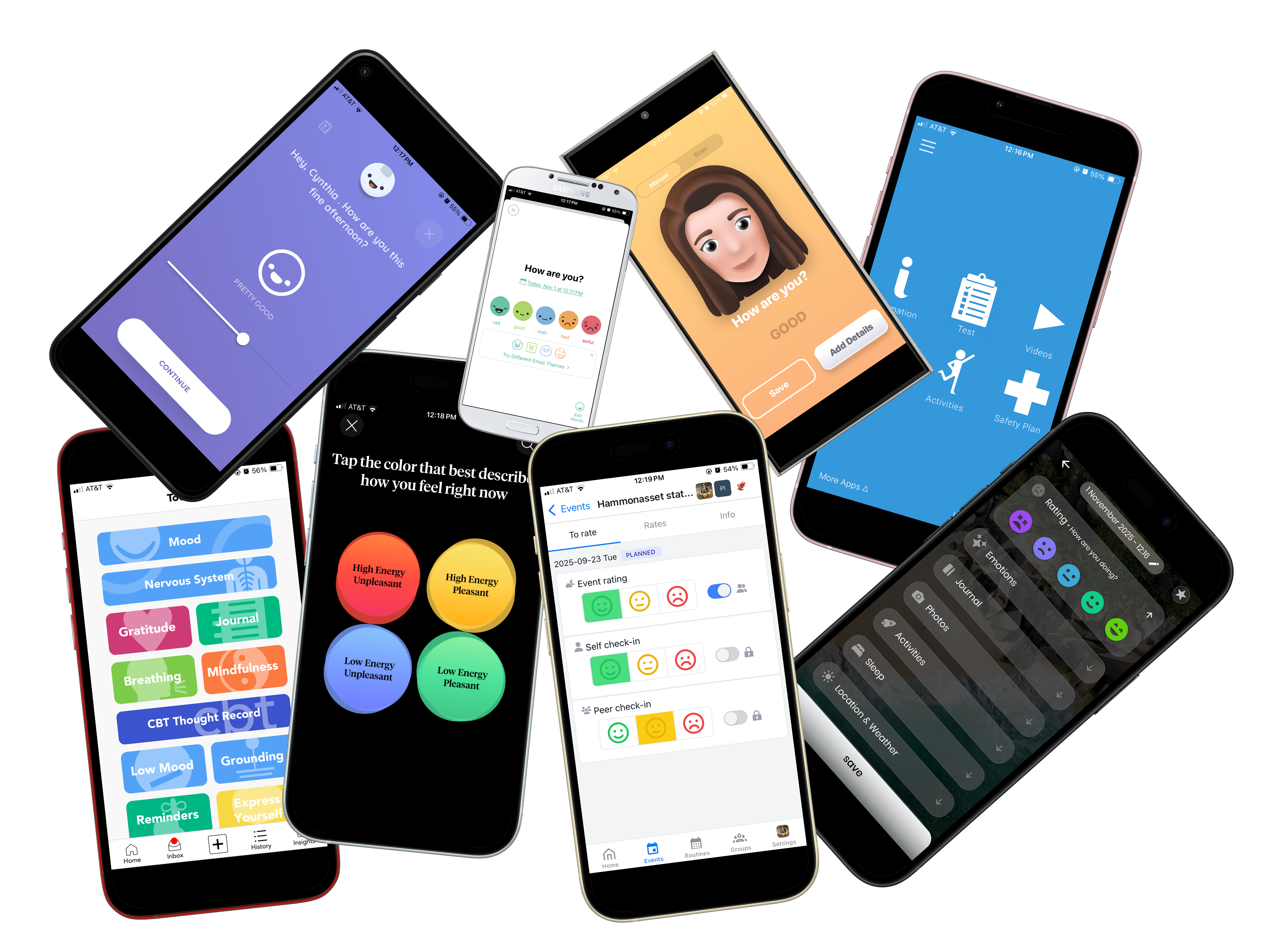
How We Feel
How We Feel is an iOS app developed through collaboration among scientists, designers, engineers, and therapists, including Dr. Marc Brackett of the Yale Center for Emotional Intelligence.
Key features:
Check-in workflow: Users begin by selecting one of four quadrants in the Mood Meter model: high/low energy and pleasant/unpleasant. Based on that choice, the app suggests more specific emotions (e.g., “empathetic,” “eager,” or “disengaged”). Each feeling is visualized with a distinct color and icon, and entries can be reviewed in a calendar view.
Tagging and journaling: After selecting how you feel, you can tag factors such as what you were doing, who you were with, or where you were, and write a short note to provide context. This feature helps build self-awareness about emotional triggers.
Social and sharing features: The app includes a “friends” feature, allowing users to share check-ins with trusted contacts and include them in their emotional reflections.
Cost: The app is completely free, making it accessible for anyone exploring emotional tracking without a financial barrier.
Why it stands out: Its science-based design adds depth for users interested not only in mood tracking but also in developing emotional intelligence and self-regulation skills. As one Reddit user notes:
“It’s an emotion tracking app … I love the interface for choosing your emotion/mood — especially how it starts by asking if you are pleasant or unpleasant and have or do not have energy.” (Reddit)
Considerations: Currently, How We Feel is available only on iOS and focuses primarily on emotions rather than on detailed analytics or activity-based tracking. Users who prefer chart-based insights or long-term behavioral correlations may find fewer features compared with other apps.
Daylio Journal
Daylio is one of the most popular mood-tracking apps available on both iOS and Android. The app enables users to create a daily entry in just two taps: select a mood (from levels such as “rad,” “good,” “meh,” “bad,” or “awful”), choose associated activities from a predefined or custom list, and optionally add notes, photos, or voice memos.
Detailed features:
Customization: You can tailor the list of moods and activities so the app fits your lifestyle rather than requiring you to adapt to its presets.
Visualizations: The app provides “Year in Pixels” charts, mood graphs, and pie charts, and it allows you to export your data (e.g., CSV or image) for sharing or backup.
Privacy and storage: Data is stored locally unless you opt for cloud backups. PIN, fingerprint, or Face ID protection is available for additional security.
Pricing: Free to download with a seven-day premium trial. Afterward, the premium plan costs $35.99 per year.
Why it stands out: Its simplicity makes Daylio ideal for users who find traditional journaling too time-consuming. As one user noted:
“Daylio on the other hand is so quick for me, I just log my mood and activities … maybe add some pictures from that day and I’m done in like 2 mins.” (Reddit)
Considerations: Since it focuses mainly on moods and activities, users seeking more nuanced emotional insights or therapeutic reflection may want additional tools. The premium subscription cost could also be a factor for some.
Reflectly — Journal & AI Diary
Reflectly is a mood-tracking app designed to blend emotional check-ins with journaling. As its name suggests, it functions primarily as a digital diary but integrates mood tracking seamlessly into the journaling experience. Reflectly is available on both iOS and Android.
Detailed features:
AI-driven journal prompts: The app encourages users to record how they feel each day through emoji or mood selection, then reflect on their emotions using guided prompts generated by its AI engine. This approach helps users move beyond surface-level entries toward meaningful self-reflection.
Mood tracking and insights: Users can log their emotional states, attach notes, photos, or voice entries, and review visualizations such as charts and graphs to identify recurring emotional patterns or triggers over time.
Positive psychology and habit building: Reflectly incorporates elements of positive psychology, mindfulness, and cognitive behavioral therapy (CBT) to help users cultivate gratitude, emotional resilience, and consistent journaling habits.
Pricing and model: The app offers basic features for free. Premium access unlocks unlimited entries, advanced analytics, and full access to personalized prompts and insights. The current premium plan is offered at a one-time payment of $19.99 (discounted from $399.99).
Why it stands out:
Reflectly appeals to users seeking an integrated journaling and mood-tracking experience. Its AI-generated prompts make it ideal for those who appreciate structure rather than facing a blank page. The combination of emotional insights and beautifully designed visuals elevates it beyond a simple diary. As TechRadar notes, “Once you manage to form a habit of writing on a regular basis, it can be wonderfully cathartic… over time, graphs are produced so you can analyze how you have been feeling.”
Considerations:
Because Reflectly relies on AI guidance and structured prompts, some users may feel uncomfortable with algorithmic involvement in their reflective process. In addition, those who prefer quick mood logging or a more activity-based tracking style may find Reflectly’s journaling emphasis heavier than necessary.
Moodnotes
Moodnotes is another popular mood-tracking and journaling app currently available exclusively on iOS. It is developed by ustwo in collaboration with clinical psychologists, and it incorporates principles of cognitive behavioural therapy (CBT) and positive psychology to support emotional awareness and healthier thinking habits.
Detailed features:
Mood logging and journaling: In Moodnotes you can simply add entries from the prompt “How are you?” You choose a mood via a face-slider (ranging from happy to sad), then optionally tap “Add Detail” (subscription required) to record the emotions you’re feeling and add contextual notes.
Thought-trap detection & reframing: If you identify a negative mood, the app guides you through recognizing common thinking traps (e.g., catastrophising, all-or-nothing thinking) and offers prompts to reframe your thought process.
Insight & trend visualizations: Over time, Moodnotes aggregates your entries into graphs and statistics, showing your dominant moods, patterns of feelings, and whether you are becoming more aware of thought traps.
Privacy & sync: The app supports iCloud sync and Apple Watch integration, enabling entries from multiple devices while keeping privacy in mind. It does not save your data on its backend and you cannot access it from other platforms.
Pricing & model: The free version allows basic mood logs and journaling. The Premium version unlocks unlimited entries, detailed statistics, “Notable Insights” articles, and deeper reflection layers. A pro subscription at $2.99 per week or $69.99 per year.
Why it stands out:
Moodnotes stands out because it goes beyond simple mood logging; it offers structured reflection based on CBT and positive-psychology frameworks. For users who want to not just record how they feel but also understand why they feel that way and develop better thinking habits, Moodnotes offers a strong option.
Considerations:
Because the app emphasises CBT-based action items rather than ultra-quick mood tracking, it requires some commitment. Users who prefer minimal friction — just tap and move on — may find the extra steps interruptive.
Moodflow
Moodflow is a flexible mood-tracking and journaling app available on both iOS and Android. It emphasizes simplicity, customization, and minimal friction in logging and reflecting on emotions.
Key features:
Easy logging: No account registration is required, as the app stores data locally on your phone for enhanced privacy.
Check-in flow: You can record a mood rating, select an emotion word (e.g., “nervous,” “cheerful,” or “bored”), add an optional journal entry or photo, and tag relevant factors.
Calendar and visualization: Entries appear in a color-coded calendar view, making it easy to visualize mood patterns over time.
Pricing: The core version is free, while the premium Moodflow Plus subscription costs $3.49 per month or $14.99 for six months.
Why it stands out: For those who value speed, simplicity, and a clean interface, Moodflow offers a balanced, user-friendly experience.
Considerations: Because of its minimalist design, users who prefer advanced analytics, therapy integration, or lifestyle tracking may find it less comprehensive than other options.
Moodfit: Mental Health Tools
Moodfit is a versatile app that combines mood tracking with mental fitness features. Available on both iOS and Android, it allows users to log their mood, journal entries, and even nervous system states. When recording a mood, users can choose from five levels — great, good, OK, poor, or bad — and add notes for context.
Features in more depth:
Tool suite: Includes a mood journal, gratitude journal, breathing exercises, mindfulness meditations, CBT thought records, and self-assessments for depression and anxiety. Users can also follow daily or multi-day guided programs.
Visualizations: Provides detailed charts and reports to help identify trends and relationships between habits and mood.
Pricing: Basic features are free. Premium subscriptions cost $9.99 per month or $39.99 per year and unlock more advanced tools and analytics.
Why it stands out: Moodfit appeals to users seeking an all-in-one platform that integrates mood tracking with mental wellness exercises and self-care routines.
Considerations: Because of its comprehensive scope, the app may feel complex for new users, and the premium price could be a barrier for casual users. The user interface is also less polished than How We Feel or Daylio. As with any self-tracking tool, consistency is essential for meaningful results.
MoodTool — Depression Aid
MoodTools is designed to support individuals managing depressive symptoms or negative moods. It is available on both iOS and Android.
Key features:
Thought Diary: Enables users to record negative or distorted thoughts and apply CBT-based reframing exercises.
Depression tests: Includes PHQ-9 self-assessment questions to help users recognize early signs of depression.
Offline use and privacy: The app operates entirely offline with no account registration required, keeping user data private.
Cost: Free in most markets, ensuring accessibility.
Why it stands out: This app is particularly valuable for those looking for practical tools to support mental health, rather than simply tracking moods. It combines evidence-based exercises with straightforward usability.
Considerations: MoodTools lacks rich visualizations or charts, which may be a drawback for users who prefer visual progress tracking. It should also be viewed as a supplement — not a replacement — for professional mental health care.
Howis Self-reflection + Feedback
Howis is a cross-platform SaaS tool that integrates mood tracking, bullet journaling, and pulse surveys. It is available on iOS, Android, and the web. The app blends emotional reflection with collaborative features that allow users to share and review experiences together.
Key features:
Multi-platform access: Entries sync across all devices, allowing easy reflection from mobile or desktop.
Event and routine tracking: Users can log events or routines, attach mood stickers, add reflections, and close feedback loops.
Social and shared reflection: Unique among mood-tracking tools, Howis lets friends or family members participate in shared events, then jointly review and reflect on them. Advanced privacy settings allow users to control what they share.
Visualization by routines and groups: Users can analyze mood trends not only individually but also across shared activities or friend groups.
Pricing: Currently in promotional release — free and ad-free.
Why it stands out: The collaborative reflection feature makes Howis particularly valuable for couples, families, support groups, or mindfulness communities interested in shared emotional awareness.
Considerations: As a newer app, Howis continues to evolve, and its user experience is still being refined for optimal performance.
Conclusion
Mood tracking is more than a digital routine — it is a mindful practice that nurtures emotional awareness, self-regulation, and resilience. Whether you prefer data-driven analytics or reflective journaling, these eight apps make emotional self-care more accessible and engaging. Integrating one into your daily routine can help you pause, recognize your emotions, and respond with greater understanding — one moment, one mood at a time.